A Hard Look at Iraq Sanctions
Magazine article — December 2001
“A Hard Look at Iraq Sanctions” by David Cortright, The Nation, December 2001.


“A Hard Look at Iraq Sanctions” by David Cortright, The Nation, December 2001.
The Security Council has significantly improved UN sanctions policy in recent years. Most notable have been steps toward sharpening sanctions design, applying more targeted measures called ‘smart sanctions,’ strengthening monitoring and enforcement, and prioritizing humanitarian concerns. Yet these advances have been compromised by competing political agendas among the five permanent members of the Security Council, inadequate compliance by member states, and a lack of institutionalized UN capacity for monitoring and enforcement.
This report discusses these countervailing trends in detail and sketches some ways in the near term in which the Security Council could improve the effectiveness of sanctions.
“Unilateral Actions Will Alienate the World,” by Alistair Millar in Sunday Rutland Herald (Vt.), 22 July 2001.
This study explores the possibility of an alternative to the UN comprehensive embargo that has been in place since 1990. Our investigation is prompted by the continued erosion of the economic sanctions and the possible breakdown of controls on Iraq’s production of weapons of mass destruction. To the extent that there is a bias in this report, it is in the direction of affirming the role of sanctions as a viable tool of Security Council action when global norms are violated, while aiming that such sanctions be as humane as possible.
“Re-energizing Sanctions,” by David Cortright and Alistair Millar in San Francisco Chronicle, 18 January 2001.
“Powers of Persuasion: Sanctions and Incentives in the Shaping of International Society” by David Cortright, International Studies, vol. 38, no. 2 (2001).
“The Limits of Coercion” by David Cortright and George A. Lopez, The Bulletin of the Atomic Scientists (November/December 2000).
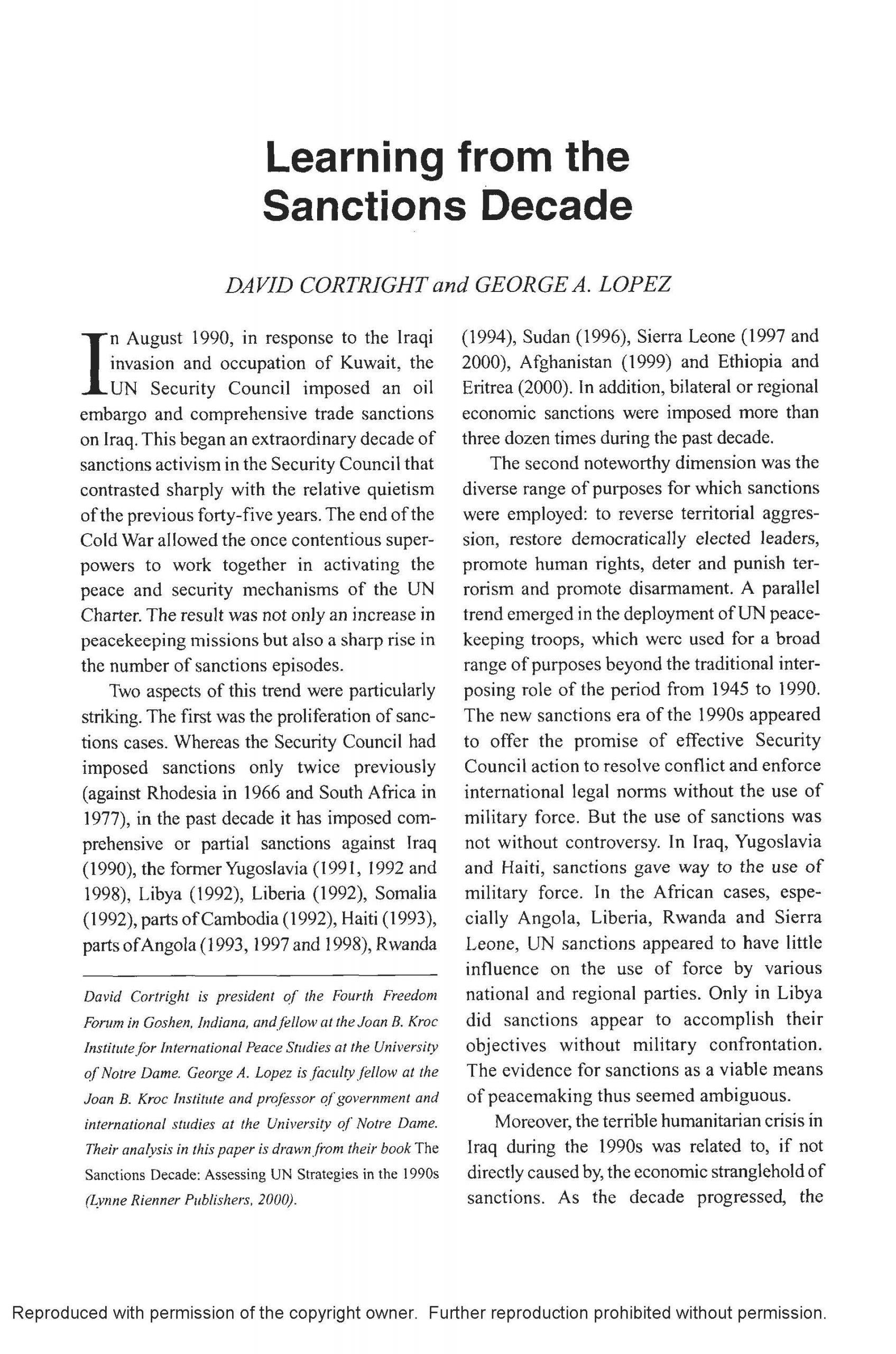
“Learning from the Sanctions Decade” by George A. Lopez and David Cortright, Global Dialogue, vol. 2, no. 3 (Summer 2000).
Report — June 2000
“Positive Inducements in International Statecraft” by David Cortright in Fraser Forum. Based on a paper of the same title commissioned by the Fraser Institute (June 2000).
In Search of the Fourth Freedom offers a timely and provocative prescription for reducing the growing threat posed by nuclear and other weapons of mass destruction. It goes beyond conventional thinking in challenging the world to replace the law of force with the force of law. It proposes a common-sense international security system based on law and enforced by economic power.